






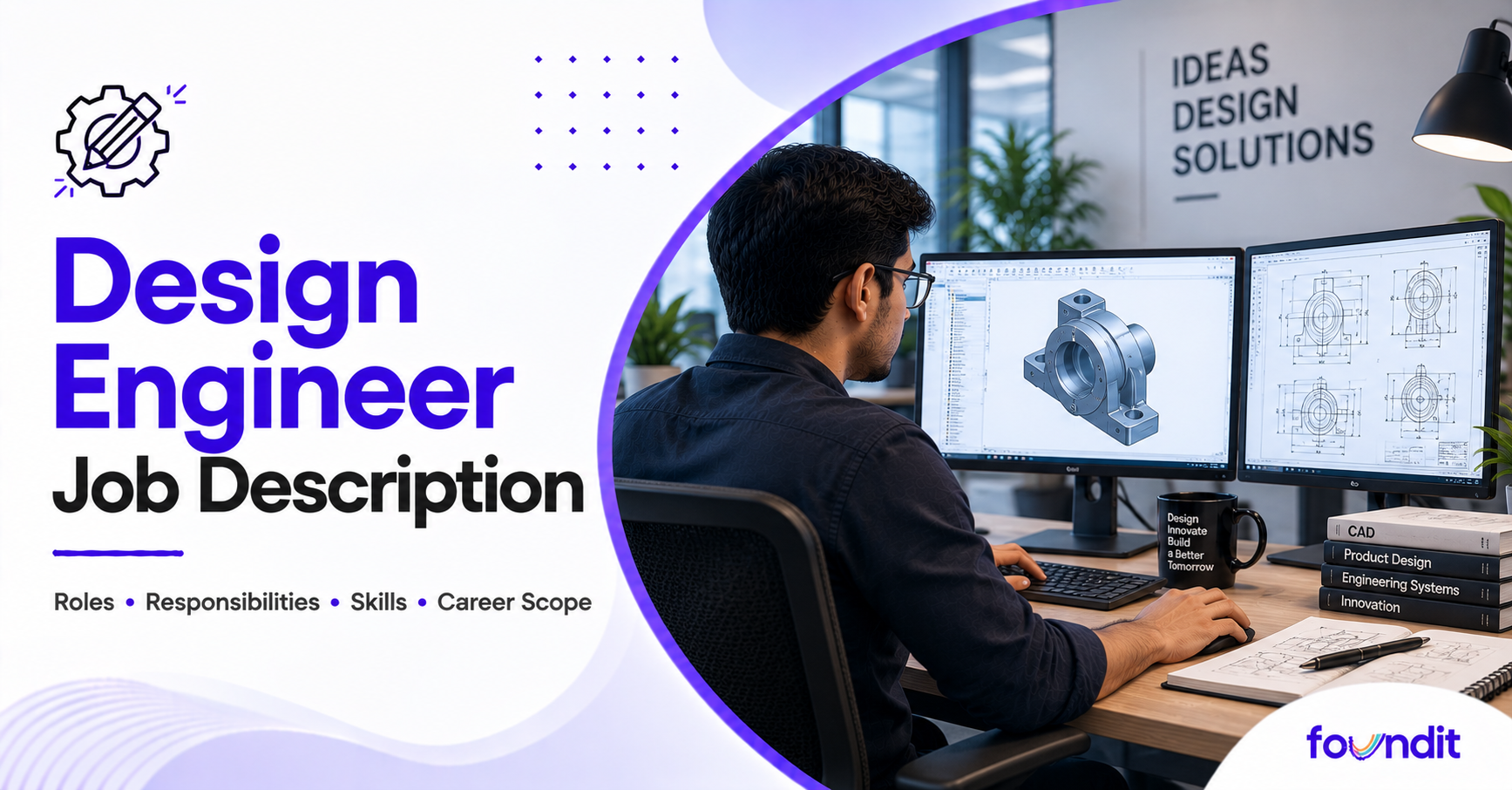
A Design Engineer develops, evaluates and improves products, components, systems or engineering solutions by combining technical knowledge with design principles. The role involves turning requirements into workable concepts, creating engineering drawings and models, selecting suitable materials, developing prototypes, testing designs and supporting the transition from concept to production or implementation.
Design Engineers work across industries such as automotive, manufacturing, construction, aerospace, electronics, energy, consumer products and industrial equipment. Their exact responsibilities depend on the engineering discipline, but most roles require a combination of CAD skills, engineering calculations, problem-solving, technical documentation, prototyping and cross-functional collaboration.
This guide explains the Design Engineer job description, roles and responsibilities, required skills, qualifications, software tools, salary, career path and how to become a Design Engineer.
Quick Overview
| Job Role | Design Engineer |
| Primary Function | Design, develop, test and improve products, components or engineering systems |
| Core Work | Concept development, CAD modelling, engineering drawings, calculations, prototyping, testing and design improvement |
| Common Tools | AutoCAD, SolidWorks, CATIA, Creo, Autodesk Inventor and other CAD/CAE software |
| Key Skills | Engineering design, CAD, technical drawing, problem-solving, mathematics, materials knowledge and communication |
| Typical Qualification | Bachelor’s degree in Mechanical, Electrical, Civil, Product Design, Manufacturing or another relevant engineering discipline |
| Common Industries | Manufacturing, automotive, aerospace, construction, energy, electronics, consumer products and industrial engineering |
| Career Progression | Graduate/Junior Design Engineer → Design Engineer → Senior Design Engineer → Lead/Principal Engineer → Engineering Manager |
What is a Design Engineer?
A Design Engineer is an engineering professional who develops practical solutions to technical requirements. They take an idea, problem or design brief and convert it into detailed specifications, models, drawings and prototypes that can be tested and eventually manufactured, constructed or implemented.
The role sits between concept development and real-world engineering implementation. A Design Engineer needs to consider whether a proposed design will function correctly, meet performance requirements, use appropriate materials, comply with applicable standards and remain practical to manufacture or build.
For example, a Mechanical Design Engineer may develop a machine component, an Electrical Design Engineer may design an electrical system, while a Civil or Structural Design Engineer may develop elements of buildings or infrastructure. The engineering principles, software and regulations differ between these specialisations, but the underlying design process is similar.
What Does a Design Engineer Do?
A Design Engineer usually works across several stages of the engineering design process. The work begins with understanding a problem or requirement and continues through concept development, modelling, testing, modification and implementation.
- Understand design requirements: Review customer needs, technical specifications, performance targets, budgets, regulations and project constraints.
- Research possible solutions: Study existing designs, materials, technologies, manufacturing methods and technical alternatives before selecting an approach.
- Develop engineering concepts: Generate and compare possible solutions based on performance, feasibility, cost, safety and user requirements.
- Create CAD models and drawings: Use computer-aided design software to produce 2D drawings, 3D models, assemblies and technical specifications.
- Perform engineering calculations: Analyse factors such as dimensions, forces, loads, tolerances, materials, heat, movement or electrical requirements depending on the engineering discipline.
- Build and test prototypes: Develop prototypes or models to evaluate whether the design performs as expected.
- Review test results: Identify design weaknesses, failures or opportunities for improvement and revise the design accordingly.
- Prepare technical documentation: Maintain drawings, specifications, calculations, design records, test results and engineering reports.
- Support manufacturing or implementation: Work with production, procurement, quality or construction teams to resolve design-related issues during implementation.
- Improve existing designs: Modify existing products or systems to improve reliability, cost, efficiency, safety, sustainability or manufacturability.
You May Also Like : Interior Designer Job Description
Design Engineer Roles and Responsibilities
A Design Engineer is responsible for ensuring that an engineering solution satisfies both technical and practical requirements. Their responsibilities may cover the complete design lifecycle, from initial research to production support.
- Review design briefs, customer requirements and engineering specifications.
- Research existing technologies, products, materials and engineering solutions.
- Create initial concepts, sketches and alternative design solutions.
- Develop detailed 2D drawings and 3D CAD models.
- Prepare dimensions, tolerances, material specifications and other engineering details required for production.
- Perform calculations and engineering analysis to verify design performance.
- Select appropriate materials and components based on performance, cost, durability and manufacturing requirements.
- Create prototypes and coordinate prototype fabrication where required.
- Conduct or support functional, performance, reliability and safety testing.
- Analyse test results and modify designs to resolve identified problems.
- Evaluate whether proposed designs can be manufactured, constructed or implemented efficiently.
- Estimate design-related material, tooling and production requirements where relevant.
- Ensure designs comply with applicable engineering standards, safety requirements and regulatory specifications.
- Maintain accurate engineering drawings, specifications, revision histories and design documentation.
- Collaborate with manufacturing, quality, procurement, project, production and other engineering teams.
- Respond to engineering problems identified during manufacturing, construction or product testing.
- Present design concepts, calculations and technical recommendations to clients, managers and other stakeholders.
- Identify opportunities to improve product performance, manufacturing efficiency, reliability and cost.
- Consider sustainability factors such as material selection, energy use, durability, maintainability and waste reduction where relevant to the project.
Design Engineering Process
Although the exact workflow varies by industry, a typical Design Engineer follows an iterative process in which designs are repeatedly evaluated and improved before final release.
| Stage | What the Design Engineer Does |
|---|---|
| 1. Requirements | Understand the design brief, technical requirements, user needs, standards, cost and project constraints. |
| 2. Research | Study existing solutions, materials, technologies and manufacturing or construction methods. |
| 3. Concept Design | Generate alternative solutions and compare their technical and commercial feasibility. |
| 4. Detailed Design | Create CAD models, engineering drawings, calculations, specifications and material selections. |
| 5. Prototype | Build or coordinate prototypes, simulations or engineering models. |
| 6. Test and Validate | Evaluate performance, safety, reliability and compliance against requirements. |
| 7. Refine | Modify the design based on test results, stakeholder feedback and identified engineering issues. |
| 8. Release | Finalise drawings, specifications and documentation for manufacturing, construction or implementation. |
| 9. Production Support | Resolve design issues and implement improvements after the design enters production or use. |
Design Engineer Job Description Sample
A Design Engineer is responsible for developing, modelling, testing and improving engineering products, components or systems. The role involves translating technical requirements into practical designs, preparing detailed CAD drawings, selecting materials, supporting prototype development and working with manufacturing or implementation teams to ensure designs can be produced efficiently and safely.
The ideal candidate should have strong engineering fundamentals, proficiency in relevant CAD software, an understanding of materials and manufacturing processes, and the ability to analyse technical problems. Depending on the role, experience with simulation, tolerance analysis, prototyping or product lifecycle tools may also be required.
Design Engineers typically collaborate with production, quality, procurement, project management, testing and other engineering teams to move designs from concept through validation and implementation.
Design Engineer Qualifications
Qualification requirements depend on the engineering discipline and industry. Most employers prefer candidates with a relevant engineering degree supported by practical knowledge of CAD tools, engineering drawings and design processes.
Educational Qualifications
- Bachelor’s degree in Mechanical Engineering, Electrical Engineering, Civil Engineering, Electronics Engineering, Manufacturing Engineering, Product Design Engineering or another relevant discipline.
- A diploma in engineering may be accepted for some junior or technician-focused design roles where strong CAD and drafting experience is demonstrated.
- A master’s degree may be preferred for specialised design, research, simulation or advanced engineering positions but is not required for every Design Engineer job.
- Professional training or certification in relevant CAD, CAE, simulation or product lifecycle software can strengthen a candidate’s profile.
Experience Requirements
| Job Level | Typical Experience | Common Expectations |
|---|---|---|
| Graduate / Junior Design Engineer | 0–2 years | CAD modelling, engineering drawings, basic calculations, documentation and prototype support |
| Design Engineer | 2–5 years | Independent design work, material selection, design validation, problem-solving and cross-functional coordination |
| Senior Design Engineer | 5+ years | Complex design ownership, advanced analysis, design reviews, mentoring and technical decision-making |
These ranges are indicative. Some employers may hire fresh graduates with strong internships, academic projects or CAD portfolios, while specialised sectors such as aerospace, automotive or heavy engineering may expect deeper domain experience.
Design Engineer Technical Skills
Technical skills vary by discipline, but the following capabilities are commonly required across Design Engineer roles.
1. CAD Modelling and Drafting
Design Engineers use computer-aided design software to create 2D drawings, 3D models, assemblies and production-ready engineering documentation. Proficiency in one or more industry-relevant CAD platforms is usually a core requirement.
2. Engineering Drawing
Engineers should understand dimensions, tolerances, sections, views, symbols, annotations and drawing standards so that designs can be communicated accurately to production or construction teams.
3. Materials Knowledge
Material selection affects strength, weight, cost, durability, corrosion resistance, thermal behaviour and manufacturability. Design Engineers should understand the properties of materials relevant to their field.
4. Manufacturing and Production Knowledge
Designs must be practical to manufacture or build. Depending on the industry, this may require understanding machining, casting, moulding, fabrication, sheet metal, welding, additive manufacturing, assembly processes or construction methods.
5. Engineering Calculations
Design Engineers apply mathematics and engineering principles to verify whether a design meets performance requirements. Calculations may involve forces, loads, stresses, tolerances, thermal behaviour, fluid flow, electrical parameters or other discipline-specific factors.
6. Prototyping and Testing
Prototype development allows engineers to evaluate design performance before full-scale production or implementation. Engineers may coordinate physical prototypes, mock-ups, simulations or test rigs and use the results to refine the design.
7. Tolerance and Fit Analysis
For mechanical and manufacturing design roles, engineers need to understand how dimensions and tolerances affect assembly, interchangeability and product performance. In some roles, knowledge of geometric dimensioning and tolerancing may be required.
8. Simulation and CAE
Some Design Engineer positions require computer-aided engineering tools to simulate structural, thermal, fluid, electrical or other performance conditions before physical testing. The required software depends on the engineering discipline.
Common Design Engineer Software and Tools
The software used by a Design Engineer depends heavily on the industry. Employers usually expect expertise in tools relevant to their existing design and engineering workflow rather than every platform listed below.
| Tool / Software | Common Use |
|---|---|
| AutoCAD | 2D drafting, technical drawings and layout development |
| SolidWorks | 3D mechanical modelling, assemblies and engineering drawings |
| CATIA | Complex 3D product design, commonly used in automotive and aerospace environments |
| PTC Creo | 3D CAD modelling, assemblies, drawings and product development |
| Autodesk Inventor | Mechanical design, modelling and documentation |
| Siemens NX | Advanced CAD, CAM and engineering design workflows |
| ANSYS | Engineering simulation and analysis |
| MATLAB / Simulink | Modelling, calculations, control-system development and engineering simulation in relevant roles |
| Revit | Building design and BIM workflows in civil, structural and building-services roles |
| PLM Software | Manage design revisions, engineering documents and product lifecycle information |
Design Engineer Soft Skills
Design engineering is highly collaborative. Engineers need to explain technical decisions, respond to feedback and balance performance, cost, safety and manufacturing constraints.
- Problem-solving: Identify technical problems and develop practical solutions based on engineering evidence.
- Analytical thinking: Evaluate design alternatives, calculations and test results systematically.
- Creativity: Generate alternative concepts when existing solutions do not meet project requirements.
- Attention to detail: Detect issues in dimensions, tolerances, drawings and specifications before they affect production or performance.
- Communication: Explain technical information to engineers, managers, clients, suppliers and production teams.
- Collaboration: Work with manufacturing, quality, procurement, project and other engineering teams throughout the design lifecycle.
- Project awareness: Balance technical requirements with schedules, cost constraints and available resources.
- Adaptability: Modify designs based on testing, feedback, production constraints or changing specifications.
Technical Skills vs Soft Skills for Design Engineers
| Technical Skills | Soft Skills |
|---|---|
| CAD modelling | Problem-solving |
| Engineering drawings | Communication |
| Materials knowledge | Creativity |
| Engineering calculations | Attention to detail |
| Simulation / CAE | Collaboration |
| Prototyping and testing | Adaptability |
| Manufacturing knowledge | Project awareness |
Design Engineer Salary
Design Engineer salaries vary according to engineering specialisation, experience, location, industry, software expertise and the complexity of the projects handled. Professionals working in specialised areas such as automotive, aerospace, semiconductor design or advanced manufacturing may have different compensation structures from general mechanical or product design roles.
According to Indeed, the average salary for a Design Engineer in India is approximately ₹24,581 per month. Actual compensation varies by employer, city, engineering discipline and experience level.
Design Engineer salaries in Singapore vary depending on engineering discipline, experience, industry and employer. Candidates should compare current job listings and salary benchmarks for their specific specialisation, such as mechanical, electrical, civil or product design engineering.
Design Engineer salaries in Malaysia depend on the candidate’s engineering discipline, location, experience and technical skills. Knowledge of industry-specific CAD, simulation and manufacturing tools can influence the level of roles available.
Design Engineer salaries in the Philippines vary across junior, mid-level and senior positions and depend on the engineering field, company, location and required software expertise.
Design Engineer salaries across Gulf markets differ by country, engineering specialisation, employer and project type. Candidates should compare current vacancies for their specific discipline because compensation can vary significantly across construction, manufacturing, energy and infrastructure roles.
What Affects a Design Engineer’s Salary?
- Engineering specialisation: Salaries can differ between mechanical, electrical, civil, automotive, aerospace, semiconductor and other design engineering roles.
- Experience: Engineers who can independently own complex designs, conduct reviews and resolve production issues generally qualify for more senior positions.
- CAD and CAE expertise: Strong proficiency in specialised tools such as SolidWorks, CATIA, Creo, Siemens NX, ANSYS or industry-specific software can increase access to specialised roles.
- Industry: Compensation varies across sectors such as automotive, aerospace, construction, manufacturing, electronics, energy and industrial equipment.
- Technical responsibility: Roles involving simulation, validation, complex assemblies, safety-critical systems or advanced product development may require deeper expertise.
- Location: Engineering clusters and major industrial centres can offer different salary ranges based on employer concentration and local demand.
- Leadership responsibility: Senior engineers responsible for design reviews, mentoring, technical decisions or project ownership may move into higher-paying lead or management positions.
Types of Design Engineer Jobs
Design Engineer is a broad job title rather than a single engineering specialisation. The type of work, technical standards and software used depend heavily on the engineer’s discipline and industry.
| Design Engineer Role | Main Focus | Common Work |
|---|---|---|
| Mechanical Design Engineer | Mechanical products and components | Develop machine parts, assemblies, mechanisms, enclosures and manufacturing drawings. |
| Electrical Design Engineer | Electrical systems and equipment | Design electrical layouts, circuits, power systems, control systems and related technical documentation. |
| Electronics Design Engineer | Electronic products and systems | Work on electronic circuits, hardware components, embedded systems and product integration. |
| Civil Design Engineer | Infrastructure and construction | Develop engineering designs and calculations for roads, drainage, utilities, buildings or infrastructure systems. |
| Structural Design Engineer | Structural integrity | Analyse and design structural elements to withstand required loads while meeting applicable standards. |
| Product Design Engineer | Physical product development | Translate product concepts into functional designs while considering materials, ergonomics, manufacturing and performance. |
| Automotive Design Engineer | Vehicle systems and components | Design automotive parts, assemblies or systems and support testing and manufacturing. |
| Aerospace Design Engineer | Aircraft and aerospace systems | Develop components and systems under strict performance, weight, reliability and safety requirements. |
| Tool Design Engineer | Manufacturing tools | Design jigs, fixtures, dies, moulds and tooling required for production processes. |
| Industrial Design Engineer | Product functionality and manufacturability | Combine engineering requirements with product usability, production feasibility and design optimisation. |
Job titles are not standardised across employers. A Mechanical Design Engineer, Product Design Engineer and CAD Design Engineer may perform overlapping work, so candidates should read the responsibilities and required software rather than relying only on the job title.
Industries Hiring Design Engineers
Design Engineers work in industries that develop physical products, infrastructure, industrial systems or engineered solutions. Major employment sectors include:
- Automotive and electric vehicles
- Aerospace and defence
- Manufacturing and industrial engineering
- Construction and infrastructure
- Electrical and electronic equipment
- Energy and utilities
- Consumer products and appliances
- Robotics and automation
- Medical devices
- Heavy engineering and machinery
- Semiconductor and electronics hardware
- Renewable energy and sustainability-focused engineering
Design Engineer Career Path
There is no single career path for Design Engineers. Professionals may progress into senior technical roles, engineering management, project management or specialist areas depending on their discipline and interests.
| Career Stage | Possible Roles | Typical Focus |
|---|---|---|
| Entry Level | Graduate Design Engineer, Junior Design Engineer, CAD Engineer | CAD modelling, drawings, documentation, basic calculations and prototype support |
| Intermediate | Design Engineer, Product Design Engineer, Mechanical Design Engineer | Independent design ownership, testing, material selection and cross-functional coordination |
| Senior | Senior Design Engineer, Senior Product Engineer | Complex designs, technical reviews, design validation, mentoring and problem resolution |
| Technical Leadership | Lead Design Engineer, Principal Engineer, Technical Lead | Technical direction, design standards, reviews and high-impact engineering decisions |
| Management | Engineering Manager, Design Manager, Project Manager | Team leadership, project delivery, resources, budgets and engineering strategy |
| Specialist Path | Simulation Engineer, R&D Engineer, Manufacturing Engineer, Systems Engineer | Deep technical expertise in a particular engineering area |
With experience, Design Engineers may also move into consulting, research and development, product management or specialised engineering roles. Continuous professional development and deeper expertise in a particular engineering discipline can support progression into senior and leadership positions.
Design Engineer vs Mechanical Engineer
A Design Engineer and a Mechanical Engineer are not necessarily the same role. Mechanical engineering is an engineering discipline, while design engineering describes the type of work performed.
A Mechanical Engineer may work in design, manufacturing, maintenance, testing, thermal engineering or other areas. A Mechanical Design Engineer is specifically focused on designing mechanical components and systems.
| Design Engineer | Mechanical Engineer |
|---|---|
| Role defined mainly by engineering design responsibilities | Professional discipline based on mechanical engineering principles |
| Can work in mechanical, electrical, civil, electronics and other fields | Works primarily with mechanical systems and technologies |
| Focuses strongly on concepts, CAD, drawings, prototypes and design validation | May work in design, manufacturing, testing, maintenance, energy or other functions |
| Software depends on the design discipline | Often uses mechanical engineering and CAD/CAE tools |
Design Engineer vs Product Designer
Design Engineers and Product Designers may work on the same product but usually approach it from different perspectives. The exact division of responsibilities depends on the company.
| Design Engineer | Product Designer |
|---|---|
| Focuses on technical feasibility and engineering performance | Focuses more on user needs, form, usability and product experience |
| Works with engineering calculations, tolerances and materials | Works with concepts, user requirements, ergonomics and visual form |
| Creates engineering CAD models and production documentation | May develop concept models, sketches and product specifications |
| Validates whether a design can function and be manufactured safely | Evaluates whether a product meets customer and user expectations |
In product development teams, Product Designers and Design Engineers frequently collaborate. The Product Designer may shape the user-facing concept while the Design Engineer determines how that concept can be engineered, tested and manufactured.
Why Choose a Career as a Design Engineer?
Design engineering suits professionals who want to combine engineering knowledge with practical problem-solving and product development. The role provides an opportunity to work across the full development cycle, from an initial concept to a product, component or system that is manufactured, constructed or put into use.
The field also offers multiple specialisation routes. A Design Engineer can build deeper expertise in areas such as mechanical design, automotive engineering, product development, simulation, electrical design, structural engineering or sustainable engineering. With experience, professionals may progress into senior design, technical leadership, project management or engineering management roles.
How to Become a Design Engineer?
Becoming a Design Engineer usually requires a relevant engineering qualification, practical CAD skills and an understanding of how products or systems move from concept to implementation. The exact path depends on the discipline, such as mechanical, electrical, civil, automotive, electronics or product design engineering.
1. Choose the Right Engineering Discipline
Start with an engineering field that matches the type of design work you want to do. Mechanical engineering is common for product and machine design, while electrical, electronics, civil and other disciplines lead to different design specialisations.
2. Build Strong Engineering Fundamentals
Develop a strong foundation in mathematics, physics, materials, mechanics, circuits, structures or other subjects relevant to your engineering discipline. Design decisions need to be supported by technical calculations rather than visual ideas alone.
3. Learn CAD Software
Gain practical experience with CAD tools used in your target industry. Examples include AutoCAD, SolidWorks, CATIA, Creo, Siemens NX, Autodesk Inventor or Revit. Focus on creating accurate models, assemblies, technical drawings and design documentation.
4. Understand Materials and Manufacturing
Learn how material properties, manufacturing methods, tolerances and assembly requirements affect a design. A technically correct concept may still fail if it is too expensive, difficult to manufacture or unsuitable for the intended operating environment.
5. Learn Prototyping and Testing
Develop the ability to create or support prototypes, interpret test results and modify designs based on evidence. In many engineering roles, the design process is iterative rather than a one-time activity.
6. Build a Design Engineering Portfolio
A portfolio can help freshers demonstrate practical ability, especially when professional experience is limited. Include selected projects that show how you moved from a requirement to a finished design.
7. Gain Practical Experience
Internships, industrial training, academic projects, competitions and entry-level CAD or engineering roles can provide experience with real design constraints, revisions, documentation and teamwork.
8. Apply for Entry-Level Design Roles
Freshers can search for roles such as Graduate Design Engineer, Junior Design Engineer, CAD Engineer, Mechanical Design Engineer, Product Design Engineer or Trainee Design Engineer, depending on their qualification and specialisation.
Design Engineer Roadmap for Freshers
| Stage | What to Learn | Practical Outcome |
|---|---|---|
| Foundation | Engineering mathematics and core subjects | Understand the technical principles behind design decisions |
| CAD Skills | 2D drafting and 3D modelling | Create models, assemblies and engineering drawings |
| Design Fundamentals | Materials, tolerances and manufacturing processes | Develop designs that can be produced or implemented |
| Analysis | Engineering calculations and basic simulation | Verify whether a design meets technical requirements |
| Prototype | Testing and validation | Identify design problems and improve the solution |
| Portfolio | 2–4 complete engineering projects | Demonstrate practical design ability to employers |
| Experience | Internship or trainee role | Learn design revisions, documentation and teamwork |
| Job Search | Resume and interview preparation | Apply for junior Design Engineer roles |
Design Engineer Projects for a Portfolio
A strong portfolio should demonstrate the engineering process rather than only display finished CAD screenshots. Useful project ideas include:
- Mechanical assembly: Design a small mechanical system with parts, assemblies, tolerances and production drawings.
- Product redesign: Improve an existing product for lower weight, easier manufacturing, better ergonomics or reduced material use.
- Structural component: Develop a component and document the loads, assumptions, calculations and design decisions.
- Electrical system design: Create schematics, layouts and specifications for a simple electrical or control-system project.
- Prototype project: Develop a CAD model, create a prototype and document the changes made after testing.
- Design-for-manufacturing project: Compare two design approaches and explain how material, tooling, assembly or production constraints influenced the final solution.
For each project, explain the design brief, constraints, calculations, CAD work, material choices, testing method and final outcome. This gives recruiters evidence of your engineering thinking, not just your software knowledge.
Design Engineer Certifications
Certifications are not mandatory for every Design Engineer role, but they can help demonstrate software proficiency or specialised technical knowledge. Useful areas include:
- AutoCAD certification
- SolidWorks certification
- CATIA or Creo training
- Siemens NX training
- ANSYS or other CAE/simulation tools
- GD&T training for mechanical design roles
- BIM or Revit certification for relevant construction and building-design roles
Software certificates are most useful when combined with engineering projects, drawings and practical design work. Employers usually value evidence that a candidate can solve an engineering problem using the tool, rather than the certificate alone.
Can You Become a Design Engineer Without Experience?
Yes. Graduate and junior Design Engineer roles are available for candidates with limited professional experience, particularly when they can demonstrate relevant engineering knowledge, CAD skills and practical project work.
Academic design projects, internships, industrial training, CAD portfolios, prototype work and engineering competitions can help freshers demonstrate their ability to interpret requirements, develop designs and work through technical problems.
Role of Sustainability in Design Engineering
Sustainability is increasingly relevant to engineering design because decisions made during the design stage can affect material use, energy consumption, product life, maintenance requirements and end-of-life waste.
Depending on the industry, Design Engineers may consider factors such as:
- Reducing material use without compromising performance or safety.
- Selecting lower-impact or recyclable materials where technically appropriate.
- Improving energy efficiency during manufacturing or product operation.
- Designing products that are easier to repair, maintain or disassemble.
- Extending product life through durability and reliability improvements.
- Reducing manufacturing waste and unnecessary complexity.
The level of responsibility varies between roles, but sustainability is increasingly becoming another design constraint alongside performance, cost, safety and manufacturability.
Design Engineer Job Description: Key Takeaways
- A Design Engineer develops and improves products, components and engineering systems from concept through implementation.
- Core responsibilities include CAD modelling, engineering drawings, calculations, material selection, prototyping, testing and design documentation.
- Common software includes AutoCAD, SolidWorks, CATIA, Creo, Siemens NX and industry-specific CAE tools.
- Design Engineers can specialise in mechanical, electrical, electronics, civil, structural, automotive, aerospace and product design.
- A relevant engineering degree is the most common educational route, while internships and practical design projects are particularly useful for freshers.
- Career progression can lead to Senior Design Engineer, Lead Engineer, Principal Engineer, Design Manager or Engineering Manager roles.
Related Article:
FAQs
A Design Engineer develops, tests and improves products, components or engineering systems. Their work usually includes CAD modelling, engineering drawings, calculations, material selection, prototyping, testing, technical documentation and coordination with manufacturing or project teams.
Common Design Engineer responsibilities include understanding technical requirements, creating design concepts, preparing CAD models and drawings, performing calculations, selecting materials, supporting prototype development, testing designs, resolving technical issues and ensuring designs meet applicable standards and production requirements.
Most employers prefer a bachelor's degree in a relevant engineering field such as Mechanical, Electrical, Civil, Electronics, Manufacturing or Product Design Engineering. Some junior roles may accept diploma holders with strong CAD and practical engineering skills.
Common Design Engineer software includes AutoCAD, SolidWorks, CATIA, Creo, Autodesk Inventor and Siemens NX. Depending on the role, engineers may also use ANSYS, MATLAB, Simulink, Revit or product lifecycle management tools.
No. AutoCAD is useful for drafting, but Design Engineers also need engineering fundamentals, technical drawing knowledge, problem-solving ability and an understanding of materials, tolerances, manufacturing or construction processes. Many roles also require 3D CAD or simulation software.
Coding is not a core requirement for most traditional Design Engineer roles. However, programming or scripting can be useful in specialised areas such as automation, simulation, optimisation, electronics, embedded systems or engineering data analysis.
Yes. Fresh graduates can apply for roles such as Graduate Design Engineer, Junior Design Engineer, CAD Engineer or Trainee Design Engineer. Internships, CAD projects, academic design work, prototypes and a technical portfolio can help demonstrate practical ability.
Important Design Engineer skills include CAD modelling, engineering drawings, mathematics, material knowledge, problem-solving, prototyping, testing, attention to detail and communication. The exact technical skills depend on the engineering discipline.
A Mechanical Engineer belongs to the mechanical engineering discipline and may work in design, testing, manufacturing, maintenance or other areas. A Design Engineer is defined mainly by design responsibilities and can work in mechanical, electrical, civil, electronics or other engineering fields.
A Design Engineer focuses more on technical feasibility, performance, materials, calculations and manufacturability. A Product Designer generally focuses more on user requirements, usability, form and product experience. The two roles often collaborate during product development.
Design Engineers work in industries such as automotive, aerospace, manufacturing, construction, electronics, energy, consumer products, robotics, medical devices, industrial machinery and infrastructure.
A typical career path can progress from Graduate or Junior Design Engineer to Design Engineer, Senior Design Engineer, Lead or Principal Engineer and then Design Manager or Engineering Manager. Engineers may also specialise in simulation, R&D, manufacturing, systems engineering or project management.
 Beware of Scammers
